regional

DOLRT: What Was Lost

As expected, on Tuesday night the Board of County Commissioners voted unanimously to discontinue the Durham-Orange Light Rail Transit project. After a failure of negotiations, this step formally discontinues the project and begins a process to reallocate the funds that had been allocated to the light rail project through an amended Orange County Transit Plan.

That process will involve lengthy conversations with community members and potential partners. A lot of time and effort, and difficult negotiation lie ahead. For me, it’s time to pause and consider what has been lost.

Correcting the Record on the Durham-Orange Light Rail Transit Project

The June 29, 2016, "Off the Rails" INDY Week piece by David Hudnall, which discusses the Durham-Orange light rail transit project (DOLRT) is a poorly researched opinion piece that does a tremendous disservice to INDY Week readers, residents of Durham and Chapel Hill, and—most importantly—current public transit riders in Durham and Orange counties who stand to benefit greatly from a significantly enhanced bus and rail transit network with DOLRT at its core.

Transit investment key to future success in Chapel Hill & Carrboro

{Cross Posted from Chapel Hill News}


Chapel Hill Transit bus

If you boarded a Chapel Hill Transit bus back in February, you might have been greeted by someone with a clipboard asking you to answer a few questions about your ride. The results of this survey were just released and include relevant and interesting findings as we think about the future of transit in our community.

These survey data tell us quite a bit about who rides Chapel Hill Transit. Most riders (88 percent) were somehow affiliated with UNC, and 93 percent of those surveyed were taking the bus to get to college or work. A majority (68 percent) ride the bus five days a week while another 21 percent use it three or four days a week.

Will Chapel Hill Transit Really Start Charging Fares?

At a work session earlier this month, the Chapel Hill Town Council received a report on the fiscal sustainability of Chapel Hill Transit. The report describes CHT's current situation as akin to “tale of two cities.” One the one hand the system has been enormously successful in attracting new ridership and on the other hand facing some fairly significant obstacles because of that sucess. The report identifies funding as the chief area of concern, noting that the urgent need for capital expenses mostly to help replace the agency's aging fleet. 

In response to the meeting, a slew of stories appeared with headlines like "Chapel Hill Transit Could Start Charging For Bus Rides." That got me and a few of OrangePolitics' other editors thinking: what would happen if the system really were to start charging fares as a way to be more sustainable? After talking it over a bit, we came up with (at least) two potential issues:

Democracy and the Quality of Urban Life

Speaking to a sizeable crowd at Duke last Thursday night, Enrique Peñalosa, former mayor of Bogotá, shared his vision for and thoughts on “Democracy and the Quality of Urban Life.”

As mayor from 1998-2000, Peñalosa radically transformed the physical form of Bogotá. He worked to incorporate the city’s remote, illegally-constructed slums into the city by building new public spaces, parks, and pedestrian and bicycle connections. He implemented aggressive policies to limit car use by eliminating parking and creating dedicated bus lanes to improve public transit. He spoke at length during his talk about how the work he carried out as mayor was designed to make Bogotá a more inclusive, equal, and democratic city.

This Week in Orange Politics: October 20-26

Early voting starts week! Don’t forget out there and let you voice be heard.

While both school boards and the Hillsborough Town Board, the County Commissioners will consider operational changes at the Community Home Trust and endorsing staff recommendations for new bus service in the central and rural parts of the county. The Carrboro Alderfolks will schedule a public hearing on the Lloyd Farm Conditional Use Permit and the Chapel Hill Town Council will review a number of development proposals.

Throughout the week, Chapel Hill Transit will hold public input meetings on the North-South Corridor.

Here’s the full summary:

CARRBORO BOARD OF ALDERPERSONS

Transit Equity: A Platform for Growth and Economic Prosperity

As counties in the Triangle move forward with plans to expand transit options and enhance mobility, please join us for a discussion about the importance of incorporating equity components into transit planning. By prioritizing and committing to equitable development, lawmakers can ensure that the benefits of transit investments are broadly shared so low- and moderate-income residents will not be left behind as new opportunities enter the Triangle.  Transit investments can be a powerful force for social and economic equity if lawmakers choose to protect residents from displacement and enhance connectivity by coordinating transit, housing, and jobs policies. The result: strong, affordable, and accessible communities. 

Date: 

Friday, July 25, 2014 - 8:00am to 9:30am

Location: 

Junior League of Raleigh, 711 Hillsborough Street, Raleigh

Chapel Hill Downtown Partnership Transit Update Meeting

Triangle Transit and Chapel Hill Transit are pleased to join forces to provide the Downtown Chapel Hill Community with updates on the Durham-Orange Light Rail Transit Project as well as Chapel Hill Transit services and projects. Find out how additional transit options will benefit and impact business and residents of Chapel Hill, proposed alignments, and timetable for construction and operation.

WHO:

Presenters:

  • Brian Litchfield, Director of Chapel Hill Transit
  • Patrick McDonough, Manager of Planning and Transit Oriented Development
  • Natalie Murdock, Public Involvement Manager, of Triangle Transit

WHAT:

Prepared presentation and Questions and Answers over light appetizers

WHEN:

Thursday, June 19, 2014, 6:00-7:15 PM

WHERE:

LAUNCH Chapel Hill, 321 W Rosemary St

COST:

Free, Please RSVP Here

By 2035, the Durham-Chapel Hill-Carrboro area is expected to add nearly 200,000 residents and approximately 120,000 jobs. In 2011, Durham County residents demonstrated their support for transit initiatives by approving the transit sales tax. In 2012, Orange County residents concurred, approving a transit tax of their own. Light rail transit between the Durham-Orange Corridor’s three main activity centers—UNC (Hospitals and University), Duke (Medical Center and University), and downtown Durham—has been proposed as a means to support the growth. Triangle Transit is pleased to report that planning for the proposed Durham-Orange Light Rail Transit (D-O LRT) Project has reached the project development phase, and Triangle Transit is studying the social, environmental, and human impacts of the proposed project. And Chapel Hill Transit’s North-South Corridor, along with other service changes, will help address growth and congestion. You may learn more about these projects at www.ourtransitfuture.com and www.NSCStudy.org.

Date: 

Thursday, June 19, 2014 - 6:00pm

Location: 

LAUNCH Chapel Hill, 321 W Rosemary St

Q & A with the Chapel Hill Transit Director

CHT Logo 

Fare-free transit service is a key amenity in our community. As a result of the Orange County Bus and Rail Investment Plan that Orange County voters passed in 2012, we are seeing improvements to our service with more to come. We ask Brian Litchfield, Chapel Hill Transit Director, some questions about those improvements and other issues surrounding transit in our community. Take a look and then share what you would like to see.  

Q & A With Brian Litchfield, Director of Chapel Hill Transit 

Thank you for this opportunity and I appreciate you sharing information about some of the initiatives Chapel Hill Transit currently has underway via OrangePolitics.  First, let me offer a quick overview of Chapel Hill Transit.

Durham-Orange Light Rail Transit Project Gets Federal Go Ahead

The news much awaited by transit supporters in Orange and Durham Counties finally came yesterday when the Federal Transit Authority (FTA) announced approval of Triangle Transit's request to enter Project Dvelopment phase on the 17-mile Durham-Orange Light Rail Transit Project. More details can be found in this press release:

DURHAM-ORANGE LIGHT RAIL TRANSIT PROJECT
GETS FEDERAL GO AHEAD FOR PROJECT DEVELOPMENT
 
Research Triangle Park, NC (2-25-14) – The Federal Transit Administration (FTA) announced today that Triangle Transit’s request to enter Project Development on the 17-mile Durham-Orange Light Rail Transit Project has been approved. 
 
“We are pleased with FTA’s decision,” said Fred Day IV, Chair of the Triangle Transit Board of Trustees.  “This represents an important milestone in the course of this project.”
 
Triangle Transit General Manager David King said, “We can now proceed to complete the environmental process, advance our engineering and make final alignment decisions.  We will also use this time to strengthen our financial plan and work with our municipal and university partners on land use and housing issues around stations.  We appreciate FTA’s vote of confidence in our work on this project.”
 
Triangle Transit asked the FTA for entry into the New Starts program in December 2013.  A Draft Environmental Impact Statement (DEIS) and Final Environmental Impact Statement (FEIS) required by the National Environmental Policy Act (NEPA) of 1969 will be completed by January 2016.
 
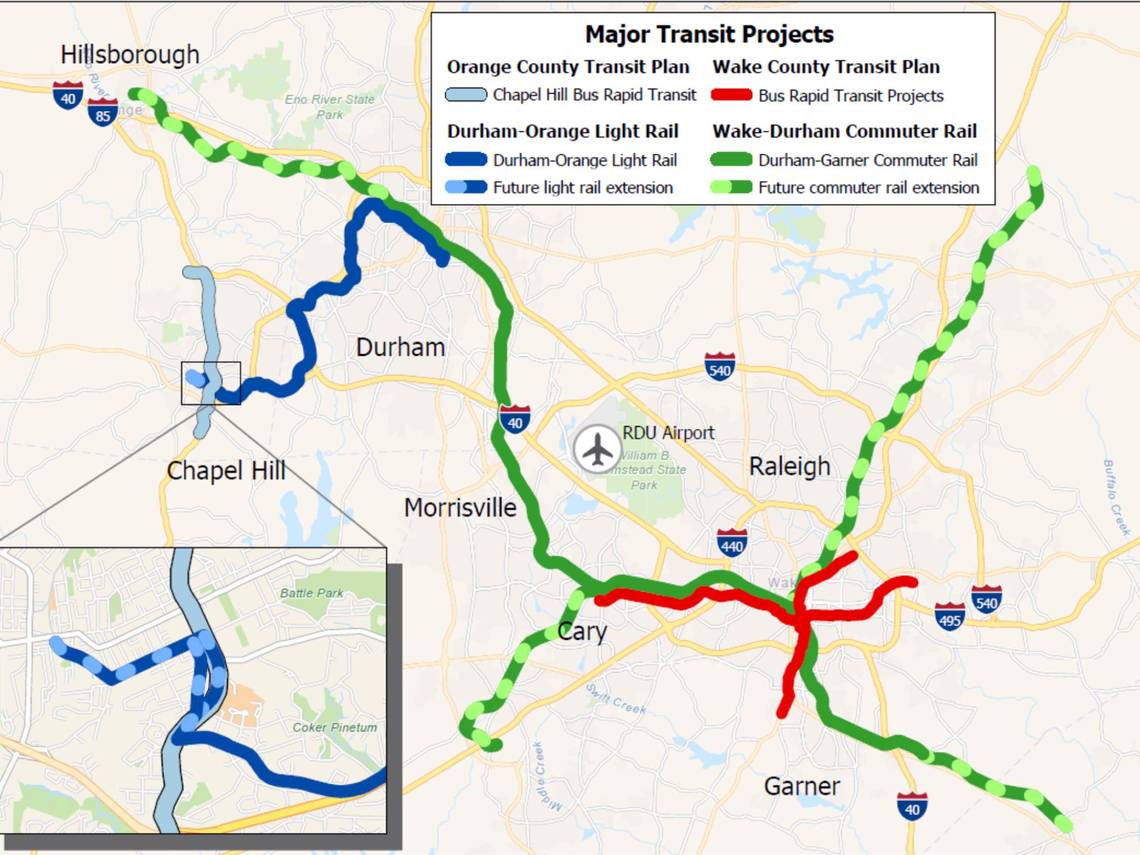
The light rail line would run from Chapel Hill to East Durham with proposed stops as UNC Hospitals and UNC, Mason Farm Road, Friday Center, Hillmont, Leigh Village, Patterson Place, South Square, Duke University, Duke University Medical Center, the VA Medical Center, downtown Durham and Alston Avenue/NC Central University.
 
The Project Development phase is scheduled to take two years. Project Development is followed by a three year phase called engineering.   Construction would follow the engineering phase and would likely take four to five years before light rail service could begin.  More information is available at ourtransitfuture.com.
 
The project cost is estimated at $1.34 billion dollars (in 2012 dollars).  Voters in Durham and Orange counties have approved a one-half cent sales tax to fund the local share of the rail project along with new and expanded bus service. 

Pages


Community Guidelines

By using this site, you agree to our community guidelines. Inappropriate or disruptive behavior will result in moderation or eviction.


Content license

By contributing to OrangePolitics, you agree to license your contributions under a Creative Commons Attribution-NoDerivs 3.0 United States License.

Creative Commons License

 
Zircon - This is a contributing Drupal Theme
Design by WeebPal.